
Hypothesis testing on a single parameter
t-test(查表)
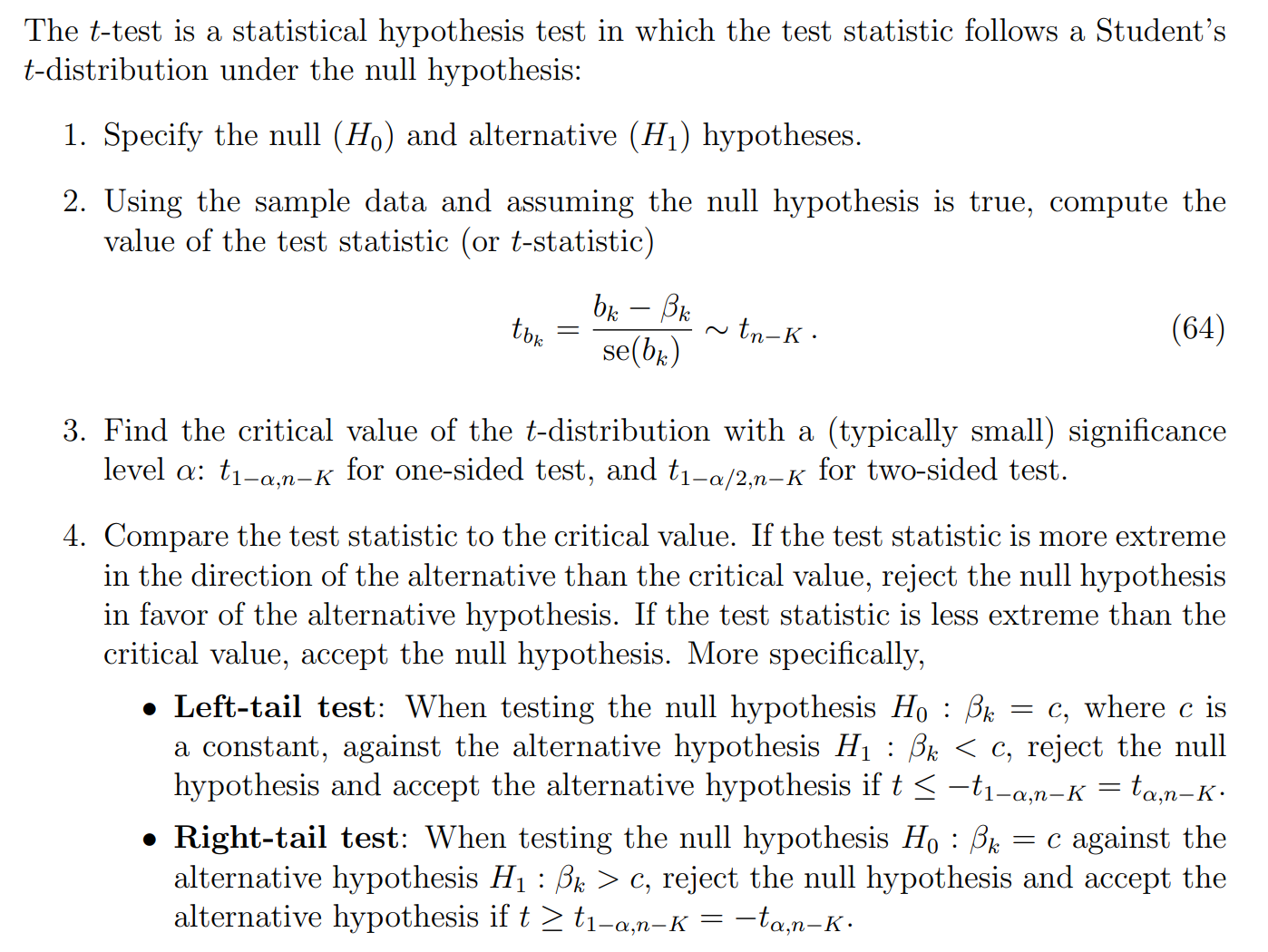

补充说明:
significant leve
In hypothesis testing, the significance level
Rejection region(拒绝域)
- 拒绝域 = 在原假设为真时,观测到的检验统计量落入极端区域(尾部)的区间。
- “极端”是相对于 备择假设所描述的方向 来定义的。
In short, the sign and form of the alternative hypothesis specify which outcomes are “extreme” or “unlikely under
p-value approach
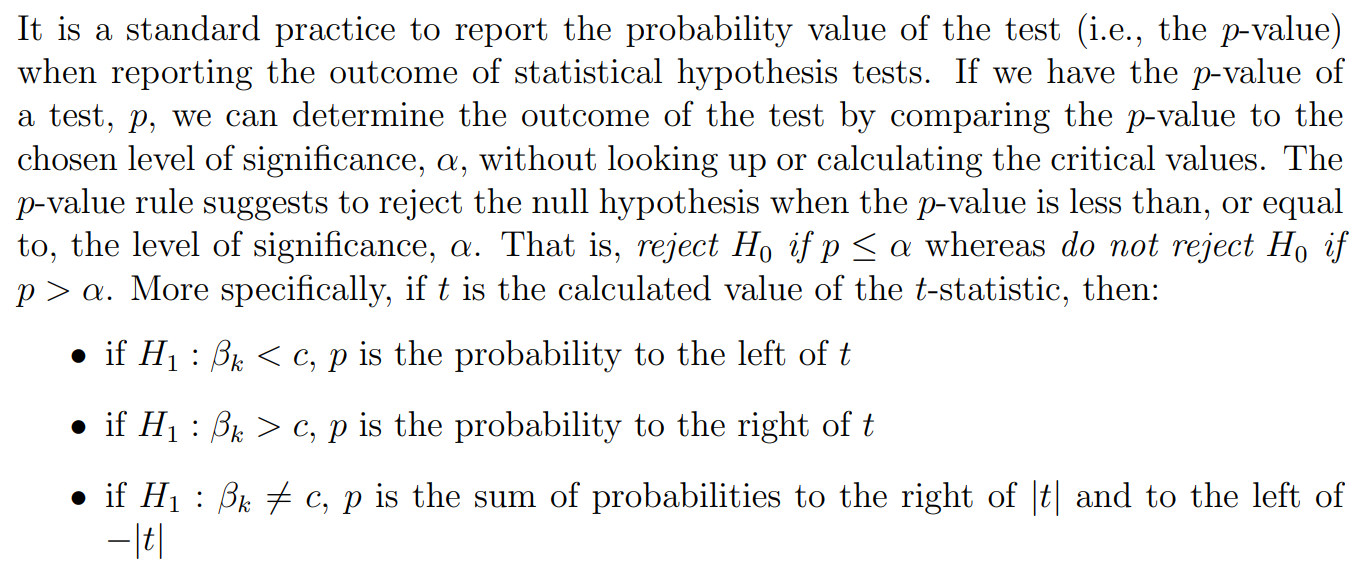
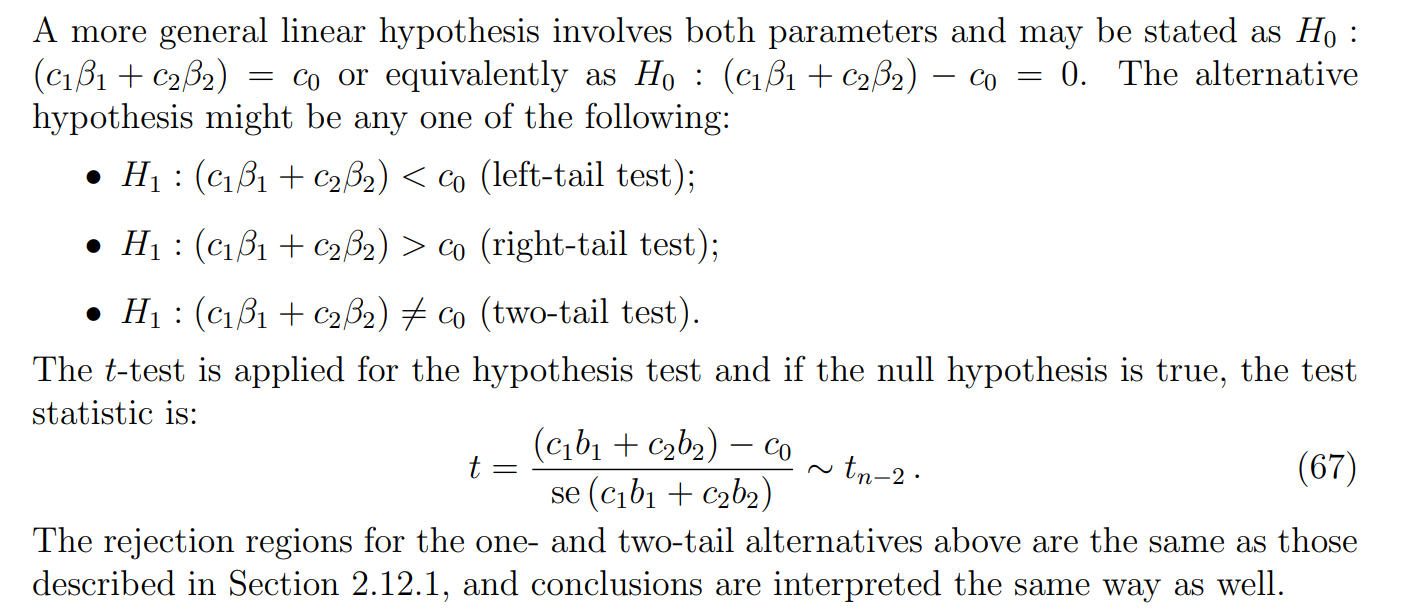
Hypothesis testing on a linear combination of parameters
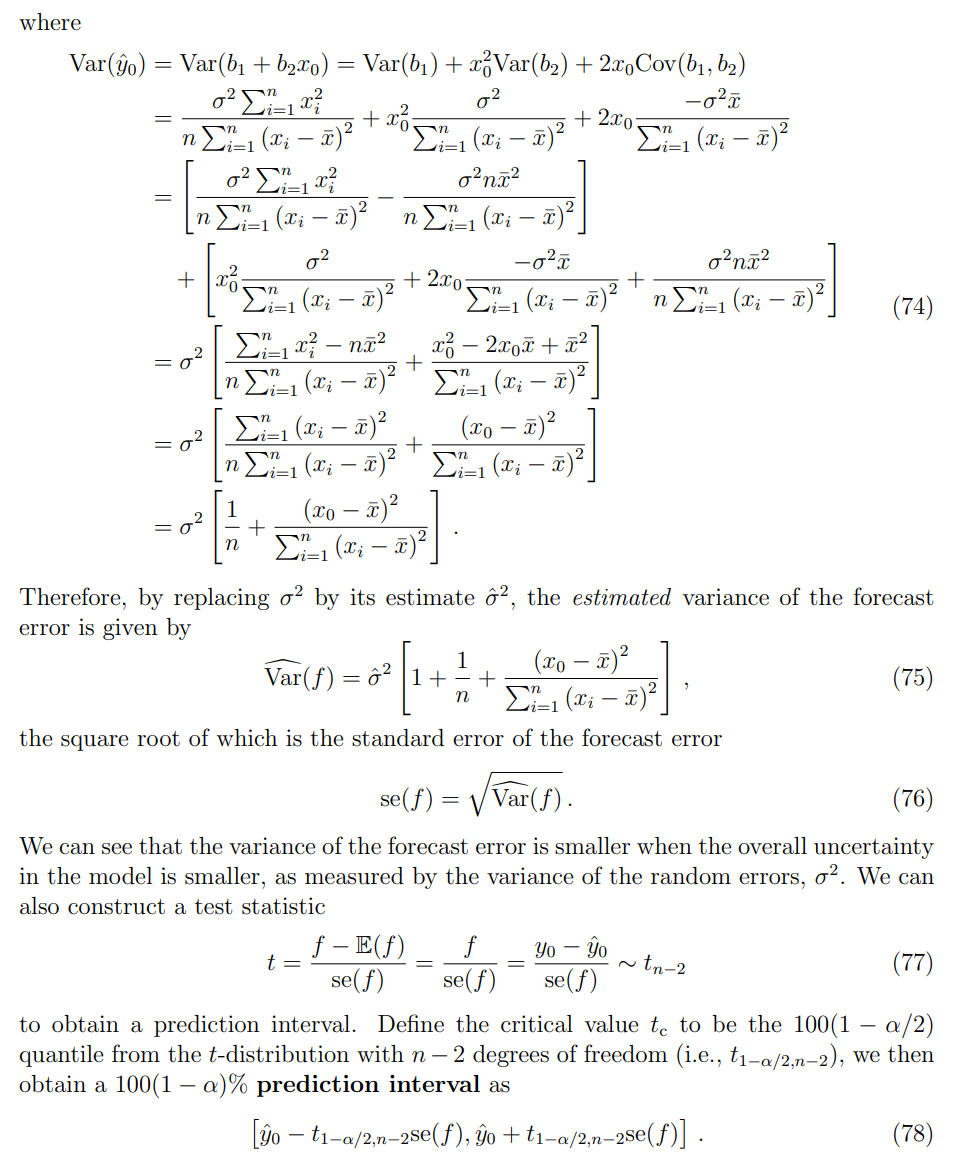
Least squares prediction
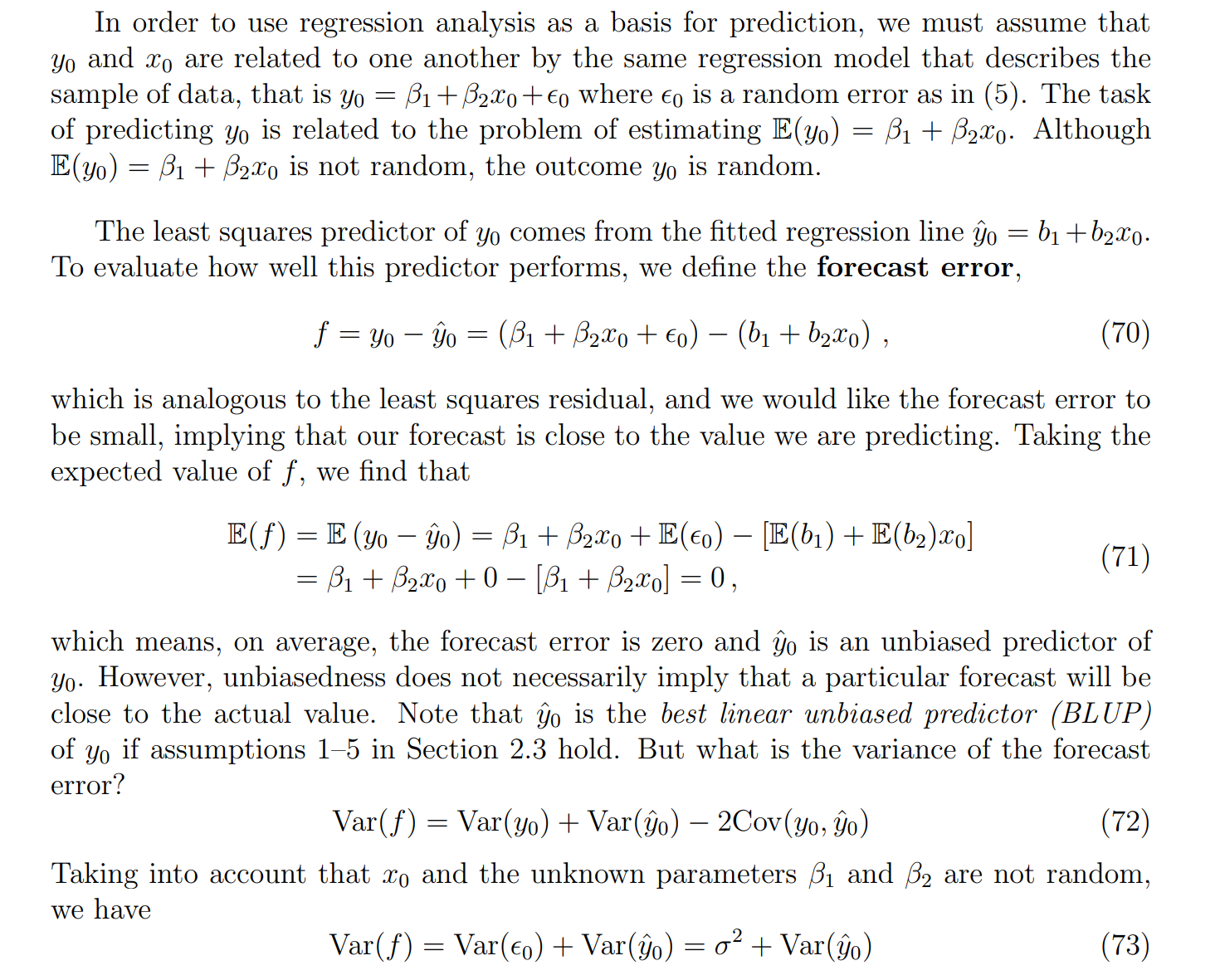
参数估计的无偏性 (Unbiased Estimation)
对象:回归系数
。 定义:估计量的期望等于真实参数。
意义:在重复抽样下,OLS 得到的系数估计在平均意义上是正确的,不会系统性偏大或偏小。
预测的无偏性 (Unbiased Prediction)
对象:预测值
与真实条件期望 。 定义:预测量的期望等于真实的条件均值。
意义:在平均意义上,预测值不会系统性偏离真实均值。
等价说法:预测误差
满足
预测区间是什么
在回归中,我们不光要给出一个预测点
,还要回答:真实的新观测值 有多大概率落在哪个区间? 这个区间就是 预测区间(Prediction Interval, PI)。
数学形式:
$$PI: \quad \hat{y}0 \ \pm \ t{1-\alpha/2, , n-k-1} \cdot se(f)$$
其中 se(f)是预测误差的标准误。
PI说明了什么
预测区间包含了两部分不确定性:
模型估计的不确定性(参数估计方差带来的影响)。
随机误差本身(每个新观测值都带有
)。
因此,预测区间 比均值响应的置信区间更宽。
Confidence Interval (CI): 针对
。 Prediction Interval (PI): 针对单个新点 Y0Y_0。
95% CI 回顾
CI 针对的是 总体参数/均值响应。
含义:如果我们不断重复抽样、建模并计算置信区间,那么其中大约 95% 的区间会覆盖真实的平均响应
。 关注的是 均值。
95% PI 的定义
PI 针对的是 未来单个观测值
。 数学表达:
$$P\Big( \hat{y}0 - t{0.975,n-k-1} \cdot se(f) \ \le Y_0 \le \ \hat{y}0 + t{0.975,n-k-1} \cdot se(f) \Big) \approx 0.95$$
含义:在固定
的情况下,未来新观测 落在区间里的概率大约是 95%。 关注的是 单个点。