Main idea of “restriction”
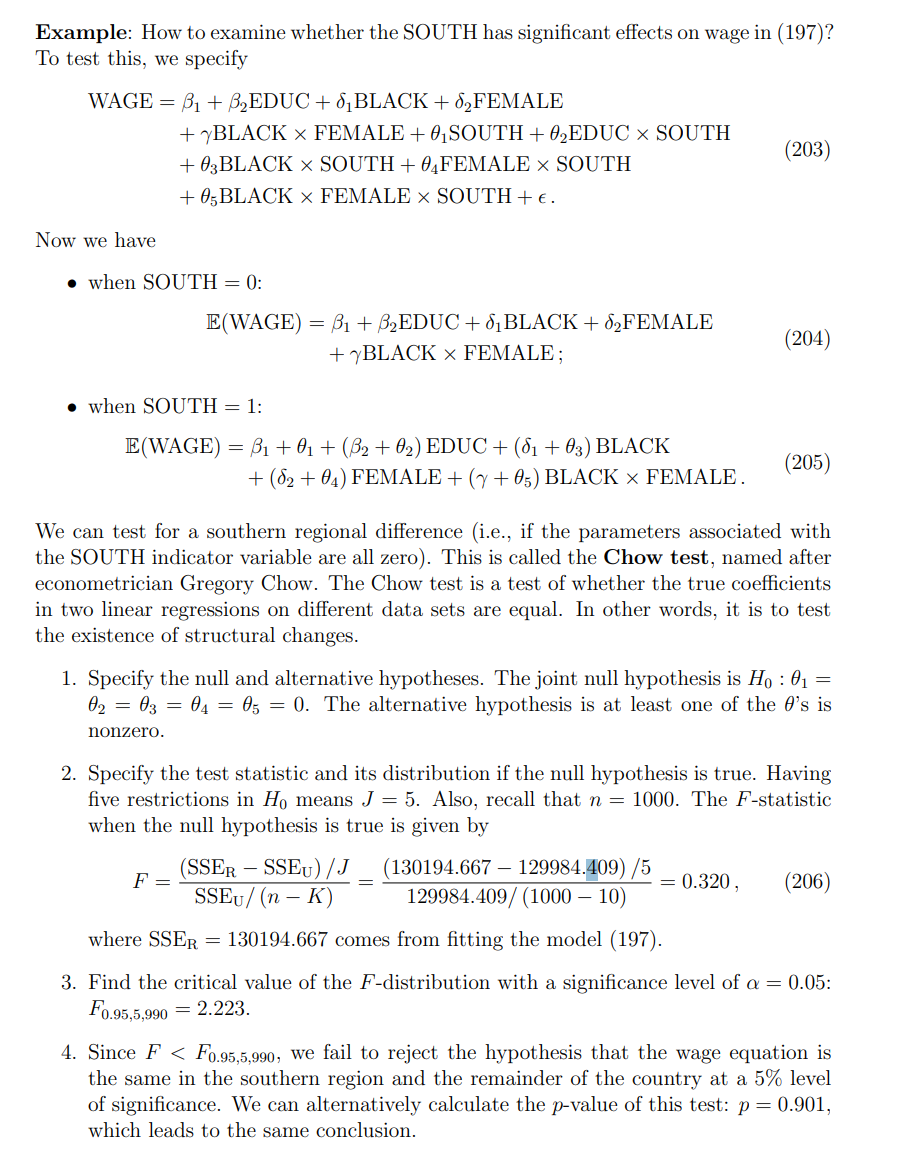
A restriction is always about which coefficients we force to equal zero under the null hypothesis. It depends on the question we want to test.
If the question is “Does SOUTH matter?”, then the restrictions only apply to the θ’s (the coefficients that multiply SOUTH and its interactions).
If the question is “Does race (BLACK), gender (FEMALE), or their interaction matter?”, then the restrictions would apply to the δ’s and γ as well.
So it’s about the hypothesis, not the variable itself.
Pooled dataset in regression
You have a dataset with all individuals, some in the South (SOUTH=1), some not (SOUTH=0).
If you run one regression using everyone together, you are using the pooled dataset.
That model assumes that all individuals — South and non-South — share the same set of regression coefficients (same intercept, same slope, etc.), unless you explicitly include interaction terms.
Contrast with split-sample
In a split-sample regression, you run two regressions separately:
one for the SOUTH=0 group,
one for the SOUTH=1 group.
This allows each group to have its own intercept and slopes.
Chow test context
Pooled regression (restricted model): assumes the South and non-South share the same parameters. That gives you one
. Separate regressions (unrestricted model): allows parameters to differ across the two groups. That gives you two SSEs
. The Chow test compares these:
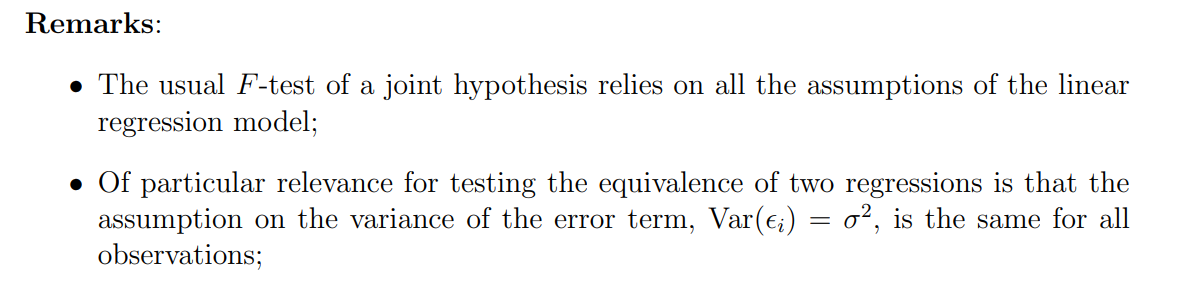
If pooling causes a much larger SSE, then the groups’ equations are not the same.
If pooling doesn’t increase SSE much, then pooling is valid.
Remark

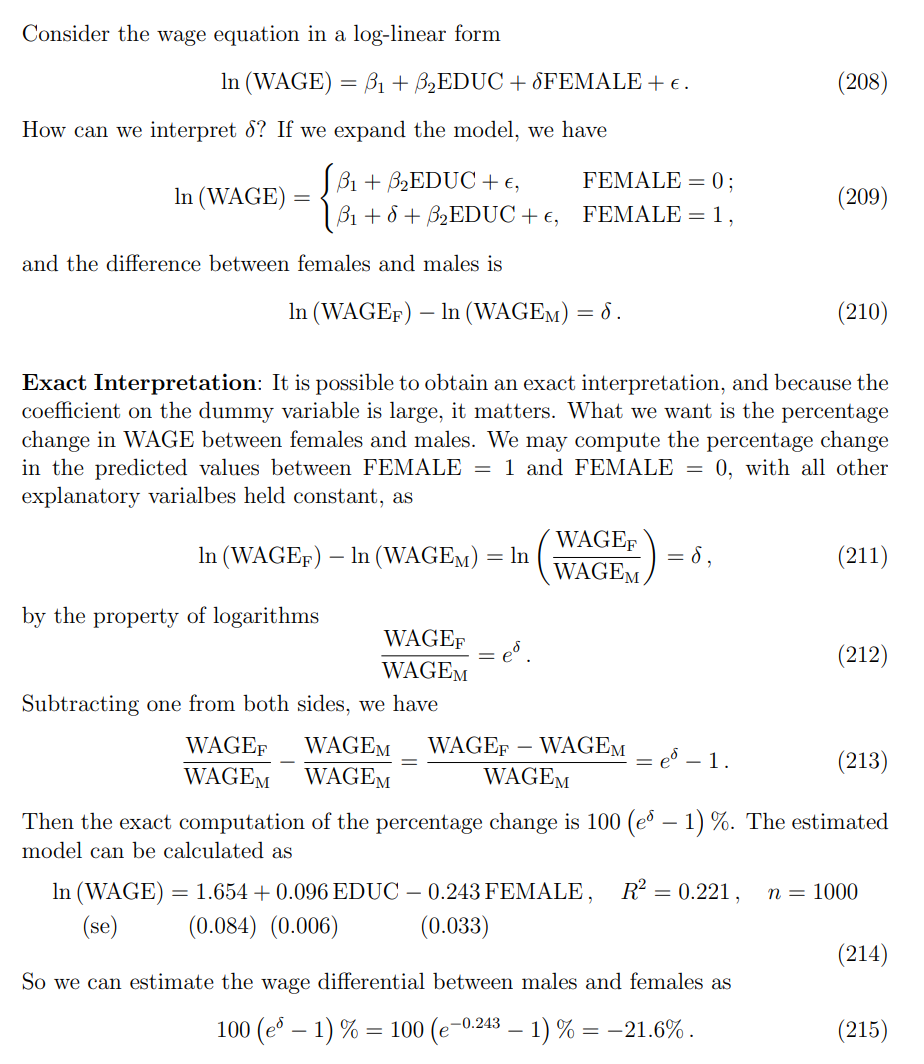
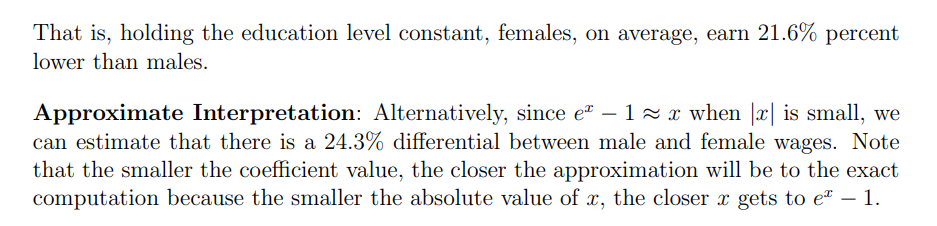
Log-linear models